
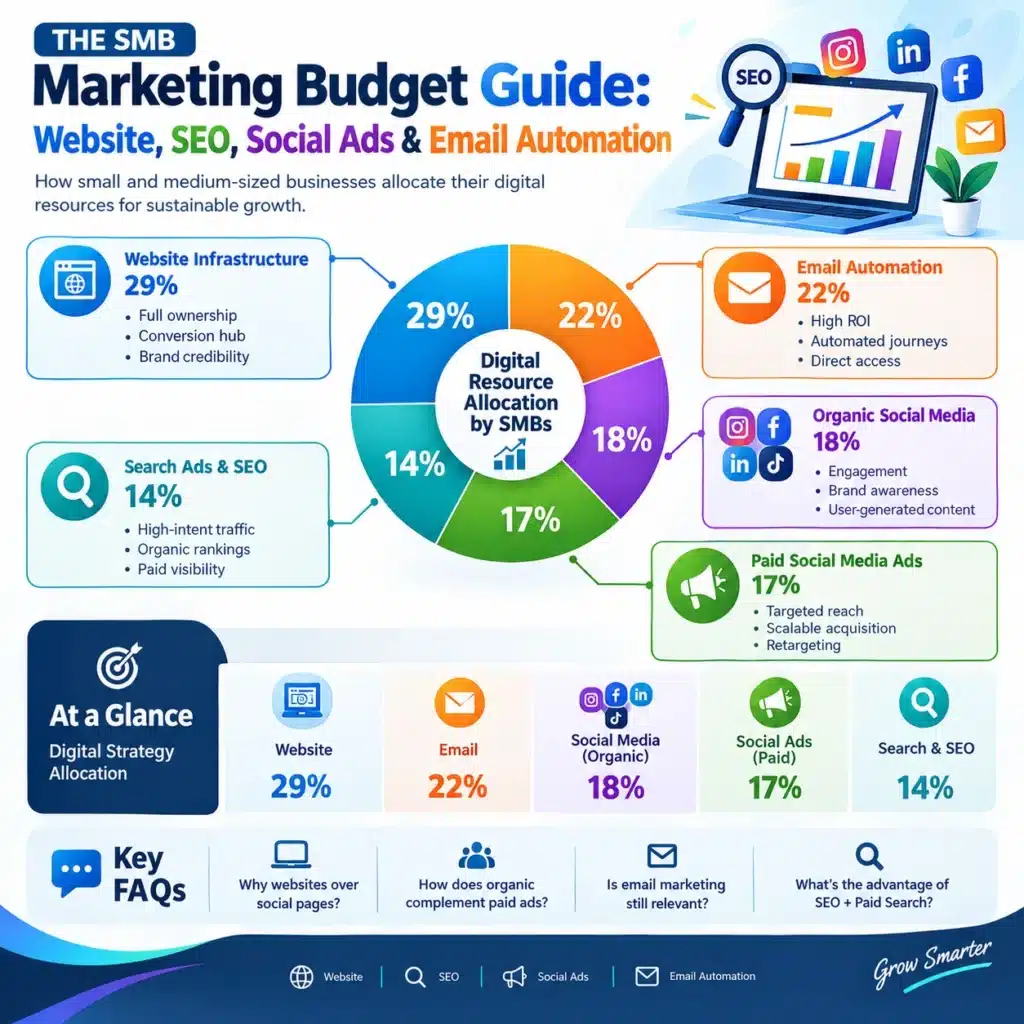
Small and Medium-Sized Businesses (SMBs) balance various digital growth channels daily. Data on Digital Resource Allocation by SMBs illustrates how modern business owners allocate marketing budgets, infrastructure investments, and organic efforts across key channels.
1. Core Digital Foundation: Website Infrastructure (29%)
Building custom storefronts and maintaining dedicated website infrastructure remain the largest areas of investment, capturing 29% of digital resource allocation.
- Owned Digital Assets: A dedicated website gives SMBs full ownership over their customer experience, free from third-party social media algorithm changes.
- Conversion Hub: Websites serve as the primary destination for inbound traffic generated across paid search, social media, and email campaigns.
- Brand Credibility: Modern consumers expect a central online storefront to verify legitimacy, browse product catalogues, and review service details.
2. Retention & Direct Communication: Email Marketing Automation (22%)
Email marketing automation commands 22% of SMB digital resources, demonstrating the enduring value of direct-to-consumer communication.
- High Return on Investment (ROI): Email remains one of the most cost-effective retention channels in digital marketing.
- Automated Customer Journeys: Automated drip sequences, abandoned cart notices, and direct newsletters maintain persistent customer engagement.
- Direct Audience Access: Unfiltered access to a subscriber’s inbox isolates communication from platform-level changes or paid reach restrictions.
3. Brand Building & Engagement: Organic Social Media Management (18%)
Organic content creation and social platform management account for 18% of SMB investments.
- Audience Engagement: Platforms like Instagram, LinkedIn, Facebook, and TikTok allow brands to engage directly with their prospective target market.
- Brand Personality & Awareness: Consistent organic posts foster community trust and build brand recall without ongoing ad costs.
- Content Sourcing: Organic social efforts generate direct customer feedback, real-time metrics, and user-generated content.
4. Paid Acquisition: Paid Social Media Ads (17%)
Paid social advertising accounts for 17% of resource distribution among SMBs looking to amplify reach quickly.
- Targeted Demographics: Granular segmentation options let businesses target specific demographic niches, geographic locations, and buyer profiles.
- Scalable Customer Acquisition: Paid social campaigns offer direct scale to bypass the time needed for organic channel growth.
- Retargeting Capabilities: Pixel-based tracking lets businesses re-engage website visitors directly through social feeds.
5. Intent-Based Capture: Search Ads & SEO (14%)
Combining organic search engine optimization (SEO) with paid search ads captures 14% of overall SMB resource allocation.
- High-Intent Traffic: Search engine marketing reaches consumers actively searching for specific solutions, goods, or services.
- Organic Search Engine Rankings: Long-term SEO efforts build passive, compounding organic web traffic.
- Paid Search Visibility: Pay-Per-Click (PPC) ads secure immediate visibility atop Search Engine Results Pages (SERPs) for critical transactional queries.
Summary Data Table: SMB Digital Strategy Allocation
Digital Channel Strategy | Allocation Percentage | Primary Business Objective |
Custom Storefronts & Website Infrastructure | 29% | Establishing brand ownership, trust, and conversion hubs |
Email Marketing Automation | 22% | Nurturing direct retention and driving predictable repeat sales |
Organic Social Media Management | 18% | Building audience trust, community engagement, and brand reach |
Paid Social Media Ads | 17% | Accelerating fast customer acquisition via targeted campaigns |
Search Ads & SEO | 14% | Capturing active search intent and building long-term search engine visibility |
Frequently Asked Questions (FAQ)
Why do SMBs still invest heavily in custom websites over social media pages?
A dedicated custom website provides total ownership of data, custom branding, and direct sales infrastructure. Social platforms restrict reach via algorithmic changes, making a website the only fully controlled digital asset for a business.
How does organic social media complement paid social ads?
Organic social builds trust, establishes brand voice, and fosters community engagement. Paid social ads use targeted budget allocation to scale to new audiences and drive direct conversions faster than organic reach alone permits.
Is email marketing still relevant for small and medium businesses?
Yes. Email marketing automation drives strong ROI because it bypasses third-party ad platforms, allowing businesses to communicate directly with an audience that has already opted in to hear from them.
What is the advantage of combining SEO with Paid Search Ads?
Combining SEO and Paid Search allows businesses to dominate top SERP real estate. Paid search provides instant visibility for conversion-focused queries, while long-term SEO builds sustainable, cost-effective organic traffic over time.

