
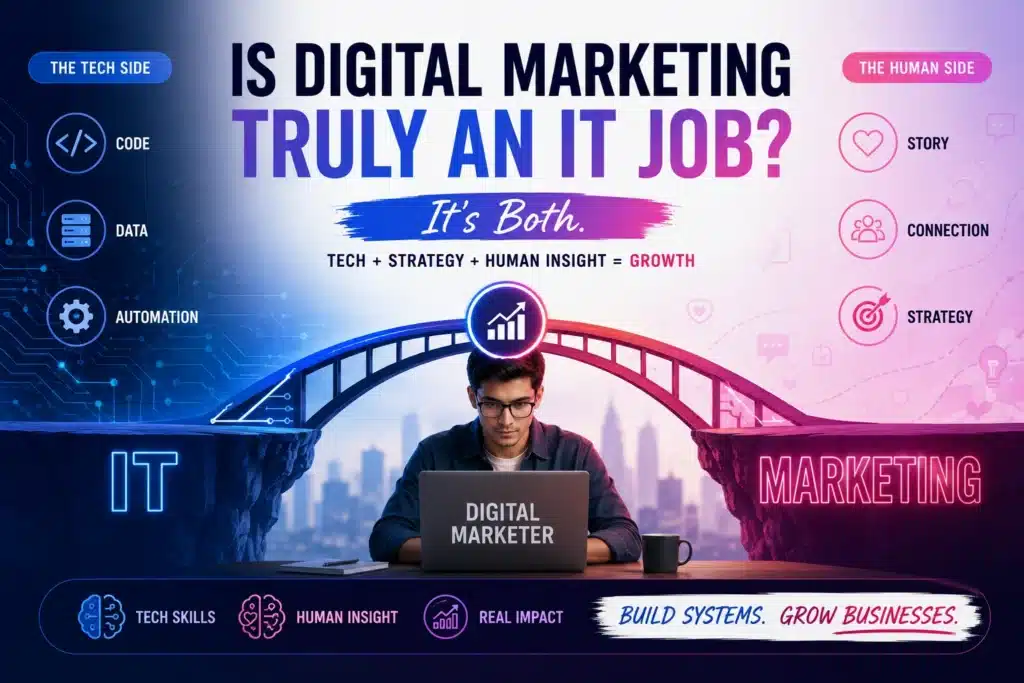
If you’ve spent any time looking at job boards lately, you’ve probably noticed something confusing. Job descriptions for marketers are starting to resemble those for software developers. This has led many students and professionals to ask: Is digital marketing an IT job?
As we move through 2026, the answer isn’t a simple yes or no. The reality is that the two fields are merging into a new kind of hybrid profession. If you are considering a digital marketing career, you aren’t just signing up to be a “creative”—you’re signing up to be a technical strategist.
Is Digital Marketing an IT Job?
Historically, IT and Marketing lived in different corners of the office. The IT department was responsible for the hardware, the internal networks, and making sure the “pipes” of the business didn’t leak. They were the architects and the engineers. Marketing, on the other hand, was the voice of the company. Their job was to tell stories and get people to care.
However, the “stage” where these stories are told has changed. Today, the stage is a website, a mobile app, or a complex social media algorithm. Because the stage is digital, you can’t perform on it without understanding how it was built. This is why many people entering a digital marketing career feel like they’ve stepped into a tech role.
Why the Lines are Blurring
Let’s be honest: you can’t do high-level SEO without knowing how a server responds to a request. You can’t run a successful Meta Ads campaign without understanding how a tracking pixel fires a piece of code back to a database.
When you decide to pursue a digital marketing career, you’re stepping into a world where “Marketing Technology” (MarTech) is the standard. It’s no longer enough to have a “gut feeling” about an ad. You need to know how to query data, how to automate workflows, and how to troubleshoot a broken integration.
The Technical Side of the Coin
If you’re worried that you’re not “techy” enough for this, don’t panic. You don’t necessarily need to be a computer scientist. But to have a long-term digital marketing career, you do need to be comfortable with technical concepts.
Take Search Engine Optimisation (SEO) as an example. A large portion of SEO is “Technical SEO.” This involves auditing site architecture, fixing crawl errors, and ensuring that schema markup is correctly implemented so Google knows what your page is about. These tasks feel very much like IT work, yet they are fundamental to marketing.
Then there is Data Analytics. In the past, marketers measured success by “brand awareness.” Today, we measure it by conversion rates, cost-per-acquisition (CPA), and customer lifetime value (CLV). Managing these numbers often requires using tools like Python for data scraping or Tableau for visualisation—skills that were once reserved strictly for the IT and data science departments.
Why Human Strategy Still Wins
Despite all this technology, we have to remember the “Marketing” part of the title. This is where the distinction from a traditional IT job remains clear. An IT professional focuses on the functional—does the system work? A marketer focuses on the emotional—does this message resonate with a human being?
The most successful people in a digital marketing career are those who can balance both. They can look at a spreadsheet of raw data (the IT side) and turn it into a compelling story that makes someone want to buy a product (the Marketing side).
If you are just starting your digital marketing career, my advice is to embrace the “tech” without losing your “humanity.” The algorithms change every week, but human psychology—the desire for connection, security, and value—hasn’t changed in thousands of years.
Is This the Right Path for You?
So, if it’s not strictly an IT job, what is it? Think of it as Digital Engineering. You are building systems that generate revenue.
If you enjoy a job where the landscape changes every day, where you get to play with the latest AI tools, and where your work has a direct, visible impact on a business’s success, then a digital marketing career is likely the perfect fit. It offers a level of variety that traditional IT roles sometimes lack, while providing a higher salary ceiling than traditional “creative-only” marketing roles.
Frequently Asked Questions (FAQ)
1. Do I need a computer science degree for a digital marketing career?
Absolutely not. While a technical background helps, most people in the industry come from diverse backgrounds like communications, business, or even the arts. What matters is your ability to learn new tools quickly.
2. Is AI going to replace digital marketers?
AI won’t replace marketers, but marketers who use AI will replace those who don’t. AI is a tool that handles the “IT-heavy” tasks, like data processing, leaving humans more time for high-level strategy.
3. What’s the biggest challenge in a digital marketing career?
The pace of change. What worked on Google or Facebook six months ago might not work today. You have to be a lifelong learner to stay relevant.
4. Can I work from home in this field?
Yes! This is one of the biggest perks. Because the work is entirely digital, many roles offer full remote or hybrid flexibility.
5. How do I get started with a digital marketing career in West Bengal?
The best way is to find a mentor or an institute that focuses on hands-on projects. At Educational Excellence, we skip the fluff and focus on the technical skills and strategic thinking that actually get you hired.


