
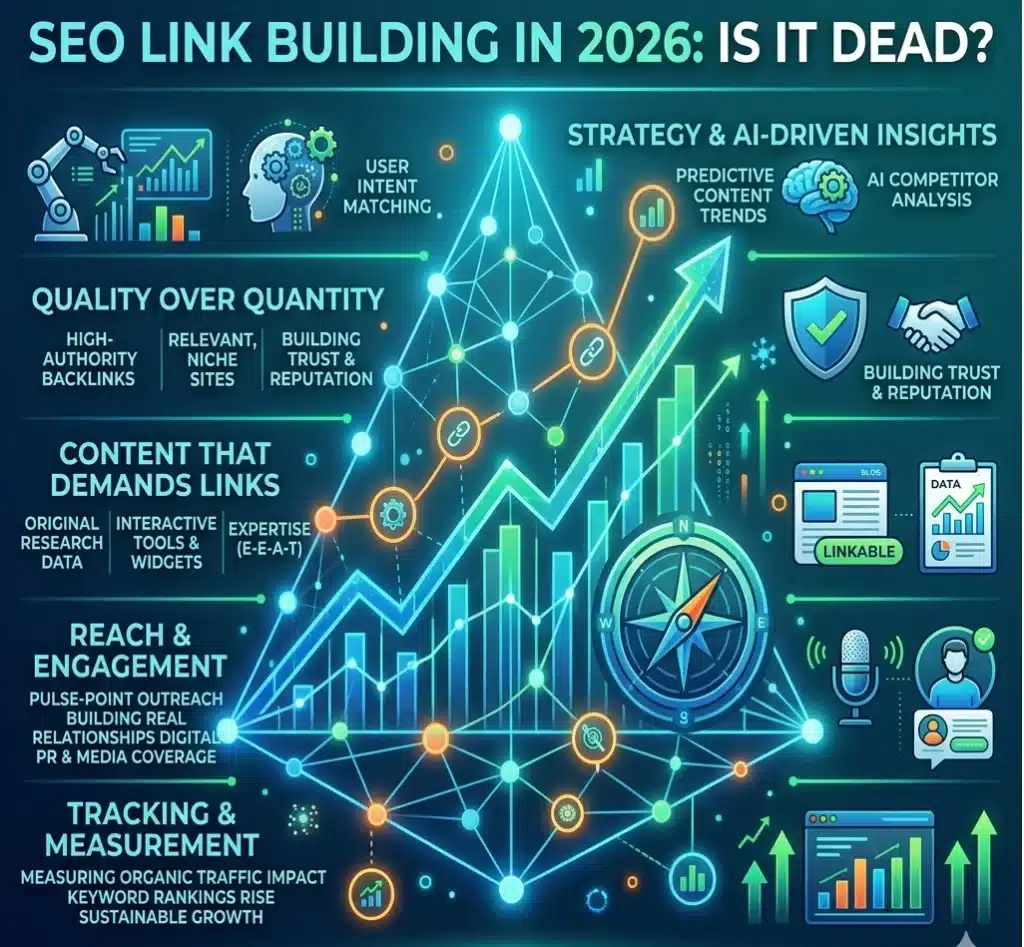
Let’s scrap the generic “blog style” and go for a “Deep-Dive Technical Guide” tone. This version focuses on the actual mechanics of SEO link building in 2026, employs a more conversational “mentor-to-student” voice, and delves into the technical LSI concepts, such as Information Gain and Entity Clusters.
Why Most SEO Link Building Strategies Fail
If you’re still counting backlinks like it’s 2015, you’re essentially chasing ghosts. By 2026, the algorithm will have moved past the “popularity contest” phase. Today, Google doesn’t care how many links you have; it cares about the “Information Gain” your content provides and the “Entity Authority” of who is talking about you.
In our workshops at Educational Excellence, we always say: “A link is a bridge. If the bridge leads to nowhere new, Google will tear it down.”
1. The Death of the “Guest Post” and the Rise of Information Gain
For years, SEOs exploited guest posting. In 2026, Google’s SpamBrain 3.0 effectively devalues any link coming from a site that doesn’t have its own “Topical Authority.”
The new gold standard is the Information Gain Score.
- The Concept: When you publish something, does it add new data to the web?
- The Strategy: Instead of writing “SEO Tips,” you should publish “The 2026 Durgapur Small Business Digital Census.”
- The Result: When local news outlets or tech blogs cite your original data, you earn a high-gain link that AI models (like Gemini and SearchGPT) use to verify facts. This makes your brand an “Anchor Entity.”
2. Navigating the “Entity” Web
In 2026, SEO is no longer about keywords; it’s about Entities.
- You are an Entity: Tapu Goswami.
- Your Brand is an Entity: Educational Excellence.
- Your Location is an Entity: Durgapur, West Bengal.
Link building now involves connecting these dots. If you receive a link from a “High DR” site about cooking, it won’t benefit you. But if you get a mention—even an unlinked mention—on a site like Search Engine Journal or a local government portal, Google’s Knowledge Graph connects your name to “Digital Marketing Expert.”
3. The “Silent” LSI Keywords You Need to Target
To rank for SEO link building in 2026, you have to speak the language the algorithm expects. You shouldn’t just repeat your focus keyword. You need to weave in these LSI (Latent Semantic Indexing) concepts:
- Contextual Relevance: The link must make sense within the paragraph.
- Link Velocity: A sudden spike of 500 links looks like a “black hat” attack. Steady, natural growth is the only way.
- Niche Citation Flow: How many “experts” in your specific field are pointing to you?
- E-E-A-T Signals: This isn’t just a buzzword anymore. Links from sites with high “Experience” scores (real humans, not AI-farms) carry 5x the weight.
The 2026 Link Building FAQ
Q: “I can buy 1000 backlinks for 5000 INR. Should I?”
A: Only if you want to see your website disappear from Google. In 2026, these “link packages” are a death sentence. One link from a reputable Durgapur business directory or a marketing influencer’s LinkedIn newsletter is worth more than 10,000 bot links.
Q: “Is it okay if all my links go to my homepage?”
A: No. This looks incredibly unnatural. A healthy SEO link-building profile in 2026 points to deep pages—your blog posts, your specific course pages (like Python or Data Analytics), and your case studies. It shows you have a “deep” site, not just a “thin” landing page.
Q: “How do I get links without asking for them?”
A: Be the “Source.” When you provide the best free tools or the most accurate local data, people link to you because it makes their content better. This is called “Passive Link Acquisition,” and it’s the most powerful ranking signal in existence.
Q: “Do social media links count?”
A: They don’t pass “Link Juice” (authority) directly, but they drive Social Signals and traffic. If 500 people click a link from your Facebook post to read your “SEO in 2026” article, Google notices that traffic and boosts your authority.
The biggest “content gap” most people have is Originality.
If you want to dominate the SERPs, stop trying to trick the algorithm. Start building a brand that the algorithm has to recognise because everyone else in the industry is talking about it.