
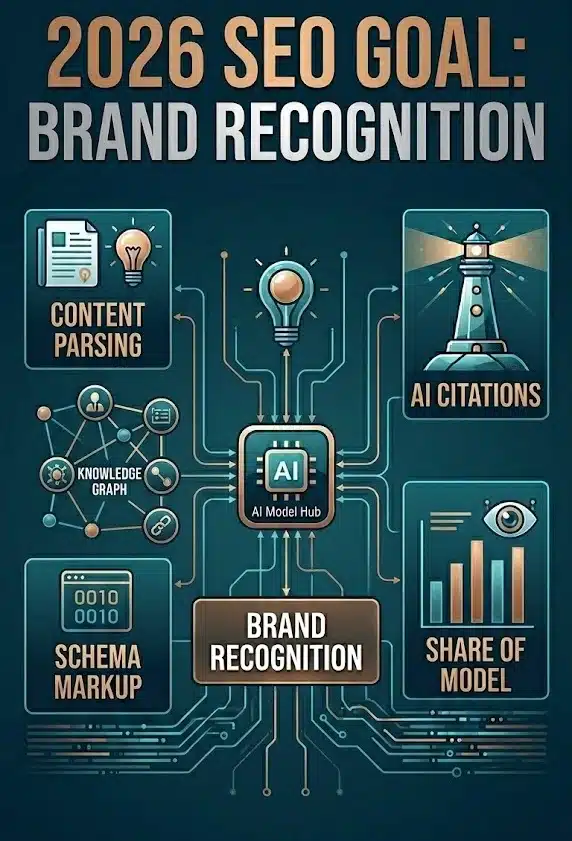
As we navigate this year, a new mantra has emerged among digital strategists: 2026 SEO new goal is no longer just about rankings; it is about brand recognition. In a world where AI answers questions before the user even clicks, being recognised by the machine is just as important as being discovered by humans.
The SEO world has shifted. If you’ve been monitoring your traffic lately, you’ve likely noticed that the old playbook—stuffing keywords and chasing a blue link at the top of page one—isn’t yielding the same results it did a few years ago.
Why Brand Recognition is the 2026 SEO New Goal
Recognition in 2026 means becoming an “Entity” that the AI trusts. When an LLM like ChatGPT or a search bot crawls the web, it looks for patterns of authority.
The Evolution of Search: From Blue Links to AI Answers
For two decades, SEO was a game of visibility. We optimised for algorithms that rewarded specific on-page signals. However, with the rise of Search Generative Experiences (SGE) and advanced Large Language Models (LLMs), the “search result” has become a conversation.
When a user asks a complex question, AI doesn’t just provide a list of websites; it synthesises an answer. If your brand isn’t part of that synthesised answer, you effectively don’t exist for that user. This is why AI-driven search optimisation has moved from a luxury to a baseline requirement. We are no longer just optimising for Google; we are optimising for Answer Engines.
Moving Toward Entity-Based SEO
Entity-based SEO focuses on the “who” and “what” rather than just the “how.” It’s about creating a digital footprint so distinct that an AI can clearly categorise your business as a leader in its niche. This involves:
- Consistency: Having identical information across all platforms.
- Context: Linking your brand to relevant topics, experts, and other authoritative entities.
- Sentiment: Ensuring the mentions of your brand across the web are positive and professional.
The Rise of Zero-Click Searches
We are seeing a massive spike in zero-click searches. This occurs when the user’s intent is satisfied directly on the SERP (Search Engine Results Page). To survive this, your content must be so authoritative that even if the user doesn’t click, they walk away remembering your brand as the source of the information. This builds “mental availability,” ensuring that when they are ready to make a purchase, they navigate directly to your site.
Strategies for Establishing Digital Authority and Recognition
To align with the 2026 SEO new goal, your strategy needs to broaden. It’s no longer enough to own your website; you must influence the “broader web” where AI bots go to learn.
1. Optimise for LLM Citations
AI models cite their sources. To get cited, your content needs to be data-rich, original, and formatted in a way that is easy for a machine to parse. Using Advanced Schema Markup is essential here. It acts as a translator, telling the AI exactly what your content represents—whether it’s a product, a review, or a scholarly guide.
2. Prioritise E-E-A-T (Experience, Expertise, Authoritativeness, Trust)
Google’s focus on E-E-A-T has reached its peak. In 2026, AI models are trained to sniff out “thin” content. To build brand recognition, your content should feature unique insights, case studies, and expert quotes that can’t be replicated by a generic AI prompt.
3. Build a “Moat” Through Content Diversification
If search engines are becoming answer engines, you need to be everywhere else. This means:
- Video Content: AI is increasingly capable of “watching” and indexing video.
- Podcasts and Interviews: Audio transcripts are goldmines for entity recognition.
- Third-Party Citations: Being mentioned in industry news, reputable blogs, and digital journals reinforces your status as a trusted entity.
Future-Proofing Your Digital Marketing Strategy
The transition from “ranker” to “brand builder” is the hallmark of a successful 2026 SEO new goal strategy. It requires a shift in how we measure success. Instead of just looking at keyword positions, we must look at the share of model—how often is your brand mentioned in AI-generated responses for your industry?
By focusing on user intent optimisation and high-value content, you ensure that your business remains relevant. The goal is to become the “default” answer in your category. When the AI is asked for a recommendation, your brand should be the first one it “thinks” of.
The landscape of 2026 is challenging, but it offers a massive opportunity for those willing to move beyond the old metrics. By embracing brand recognition and focusing on entity-based SEO, you aren’t just chasing an algorithm—you are building a lasting digital legacy.
Don’t wait for your rankings to drop before you adapt. Start treating your brand as an entity, prioritize authority, and make recognition your primary objective.
Ready to Master the New Era of Search?
The rules of SEO have changed, but your growth shouldn’t stop. Whether you are looking to audit your current strategy or build a brand that AI models trust, we are here to help you navigate the 2026 landscape.
Explore Our Digital Marketing Services
Frequently Asked Questions (FAQ)
Q: What is the primary difference between SEO in 2024 and the 2026 SEO new goal?
A: In 2024, the focus was still largely on achieving top rankings for specific keywords. In 2026, the goal is “Recognition”—ensuring that AI models and LLMs recognize your brand as a trusted authority, leading to citations in AI-generated answers and higher trust among users.
Q: How do AI Overviews affect my website traffic?
A: AI Overviews often satisfy user queries directly on the search page, which can lead to a decrease in traditional “click-through” traffic for simple questions. However, they increase the value of “Recognition,” as being cited by the AI builds immense brand trust.
Q: What is Entity-Based SEO?
A: Entity-based SEO is a technique that focuses on helping search engines understand the relationships between different “entities” (people, places, brands, and things). Instead of just matching keywords, it helps AI understand the context and authority of your brand.
Q: Does Schema Markup still matter in 2026?
A: It matters more than ever. Advanced Schema Markup provides the structured data that AI models need to accurately identify your brand, products, and expertise, making it much more likely that you will be featured in AI-driven search results.
Q: How can I improve my Brand Recognition for AI?
A: Focus on building high-quality citations on third-party sites, maintaining consistent brand information across the web, and producing original, expert-led content that demonstrates clear E-E-A-T.